 Jason Peterson
 Claude can read a job description, compare it against your experience, identify gaps, draft a tailored resume, and write a cover letter that doesn’t sound like it was written by a robot — all in about ninety seconds. MCP servers let AI tools talk directly to platforms, pull real data, take real actions. And none of it matters if the data lives behind walled gardens that refuse API access by design.
You can build the most sophisticated agent swarm imaginable and it’ll bounce off LinkedIn’s login page like a bird hitting glass.
LinkedIn: A tale of two customers
LinkedIn doesn’t have a public job search API. The world’s largest professional network, 15.7 million active job listings, and there is no way for an AI agent to search those jobs programmatically. The Job Posting API exists, but it’s write-only. Employers can post to LinkedIn. You cannot read from it.
When a company called hiQ Labs scraped public LinkedIn profiles, LinkedIn sent a cease-and-desist — and hiQ sued LinkedIn first, arguing the public data was fair game. The case went to the Supreme Court and back. hiQ ultimately paid $500,000 and was forced to destroy all of their code and data. Accounts that show signs of automation get banned. CAPTCHAs block agents. LinkedIn limits even manual browsing to about 50 profiles a day.
Here’s what LinkedIn offers the people who actually pay the big bills:
| What Employers Get | What You Get |
|---|---|
| Recruiter ($170–$835/mo) | Premium Career ($29.99/mo) |
| AI Hiring Assistant | A “Top Applicant” badge |
| 20+ advanced search filters | Basic keyword search |
| Talent Insights + market data | ”Who viewed your profile” |
| Job Posting API (write access) | No API access. None. Zero. |
| 150 InMails/mo to candidates | 5 InMails/mo to recruiters |
| ATS integrations via Partner API | ”Easy Apply” → resume black hole |
LinkedIn generated $17.8 billion in revenue last fiscal year. Talent Solutions (the employer-facing tools) accounted for roughly $9.6 billion of that. A two-sided marketplace where all the power tools go to the side that writes the big checks. The side that desperately needs help, job seekers facing 240+ applicants per posting, where 88% of employers in a Harvard Business School study acknowledged their automated screening filters out qualified candidates, gets a feed full of ads and “I’m humbled to announce” posts.
This isn’t a bug. It’s the business model.
The man behind the curtain
And who built this walled garden?

Reid Hoffman and Jeffrey Epstein on Little St. James, 2014. From the DOJ Epstein document release.
Reid Hoffman. LinkedIn’s co-founder and long-time chairman. His name appears in 2,658 separate files in the Department of Justice’s Epstein document release. He visited Jeffrey Epstein’s private island Little St. James in 2014, with a second trip planned later that year. His Christmas Eve 2014 email, released just weeks ago in the latest DOJ data dump, included this:
“ice cream… for the girls”
And a reference to something that would:
“strike your funny bone for the island”
No victim of Epstein’s sexual exploitation has made any public allegation of wrongdoing against Hoffman specifically. He has described his visits as related to MIT Media Lab fundraising and called them a “major error of judgment.”
You can decide for yourself whether this is the person who deserves your $30 a month and your daily attention.
There’s a way out
Indeed, the world’s largest job aggregator, did something LinkedIn would never do. They shipped an official MCP server. A direct integration that lets Claude search Indeed’s entire job marketplace from inside a conversation. No scraping. No hacks. No premium tier.
Here’s what it looks like:
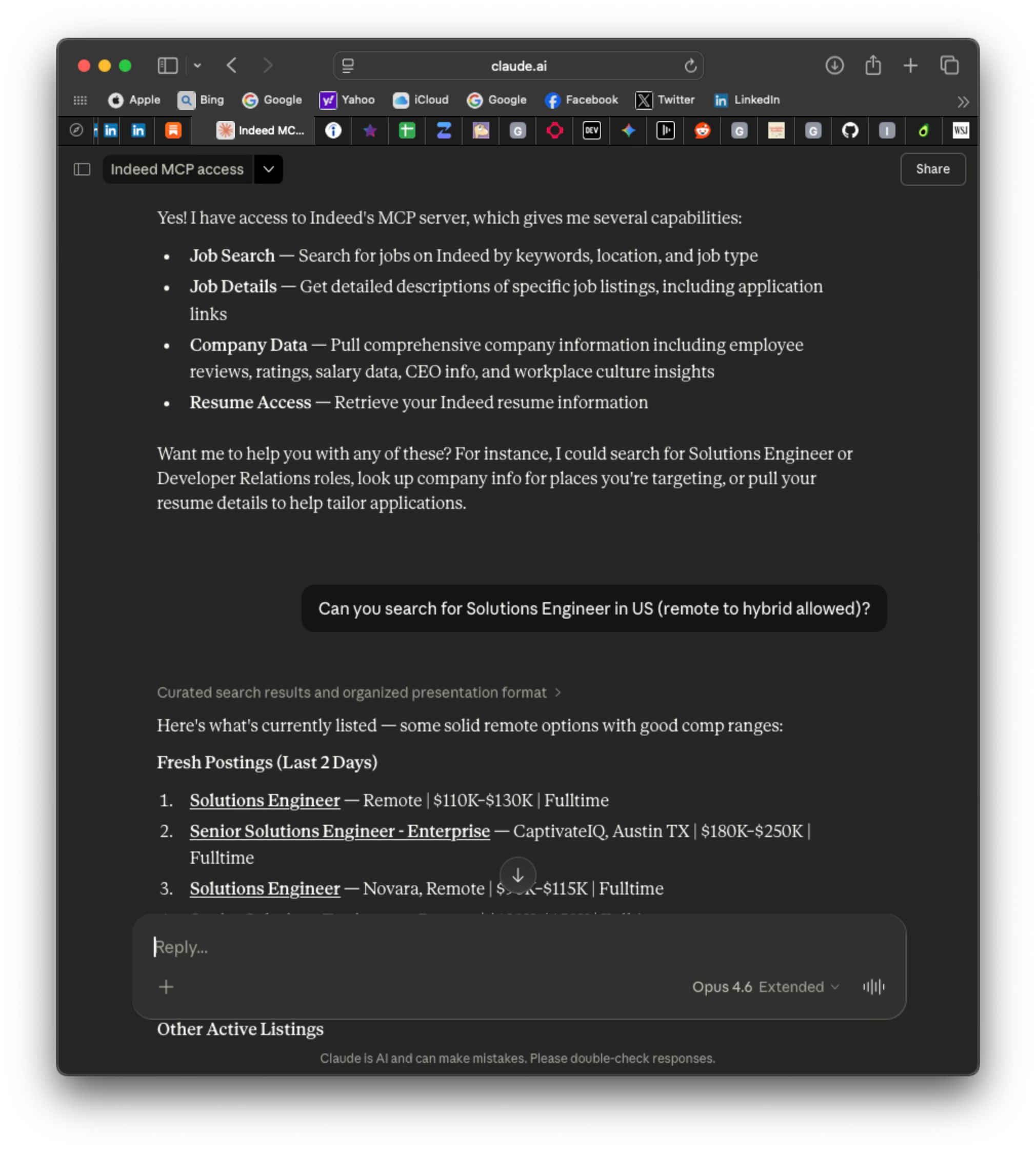
That’s a real search I ran while writing this article. Full job descriptions. Salary ranges. Direct links to employer career pages. No ads, no “promoted” listings, no algorithmic manipulation of results. Indeed actively routes you past itself and straight to the employer.
Indeed made a strategic choice: being the open infrastructure layer for the AI agent era matters more than trapping eyeballs on indeed.com. While LinkedIn walls off its data and sues anyone who tries to access it programmatically, Indeed says: search from Claude, search from wherever you want. We’ll be the plumbing.
The fine print
The MCP server works in Claude Desktop and claude.ai. It does not, as of this writing, work in Claude Code. I got through authentication fine, but the server won’t restart after the OAuth flow completes. The docs steer you toward Claude Desktop, and that’s where the integration runs cleanly. But Claude Code is where the real automation would live — chaining job discovery into analysis into tailored applications.
I don’t know if this is a bug on Indeed’s end, a configuration issue, or something I’m missing.
If you’ve gotten the Indeed MCP server working in Claude Code, I want to hear about it. Drop it in the comments. Let’s figure this out together.
LinkedIn built a walled garden and put a $30/month gate on the job seeker’s side. Indeed opened a door. The tools to walk through it already exist — they’re just waiting for more platforms to stop blocking the way.