 Jason Peterson
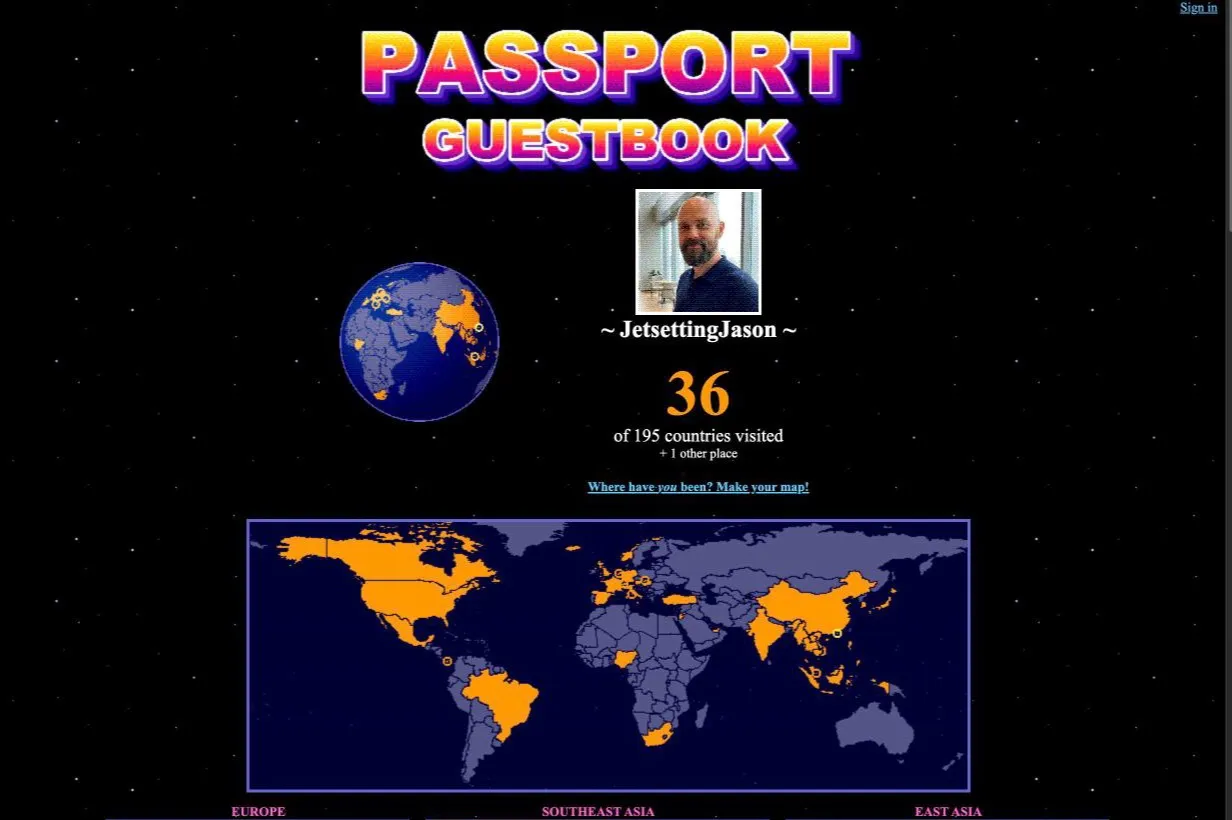
Every country you’ve ever been to, on one glowing map, built like it’s 1996. An AI agent reads your old travel emails, reduces them to countries and years, and you publish the map. There’s a guestbook, because it’s 1996.
The idea that didn’t work
I started this to try WebMCP, a proposed standard that lets a web page hand an AI agent real tools. The agent operates the page directly instead of screenshotting and clicking. I built three tools on the “make your map” page and wired an agent up to call them.
It works, in a narrow box. You need a special browser build with the feature turned on, and an agent already living in that tab. But the real problem was architectural. The agent that can read your Gmail lives in your terminal. The agent in your browser cannot read your Gmail. WebMCP solves “agent operates the page.” My problem was “agent knows things the page needs.” Different problem.
The idea that did
The boring version won: the agent prepares, you publish.
You paste one sentence into Claude Code. It reads a plain-text instruction file on the site, searches your email year by year, and asks only what email cannot answer, like whether a place was a layover. It sends back a list of countries and years, nothing else. You open a private link, tick anything it missed on a clickable map, and press the button. The browser never needs an agent. The site never sees your email.
No Claude Code? Doing it by hand takes about two minutes with the same map.
A human in the loop turns out to be exactly right. You know your own trips better than any inbox does.
The part that surprised me
Agents miss trips. My first real run found 30 places. A later run with the same instructions missed five, and told me it was finished with full confidence.
So I built an eval: a fake traveler with 2,234 synthetic emails over 18 years, seeded with traps. Layovers, a cancelled trip, a hotel booked for someone’s mom, a friend’s forwarded itinerary. The fix was not a smarter model. It was a better search recipe: one year at a time, three specific searches each, follow every new sender, then a coverage check at the end. That took it from as low as 13 of 21 countries to 21 of 21, three runs in a row.
The intelligence was never the issue. The instructions were.
Go make one
Make your map, or just look at mine. Then sign the guestbook. It’s 1996. That’s what we do.